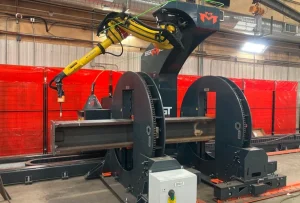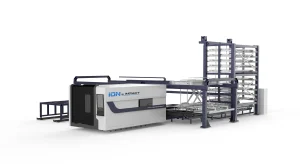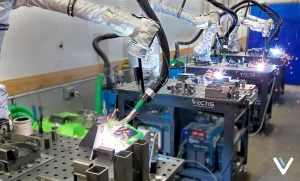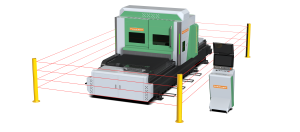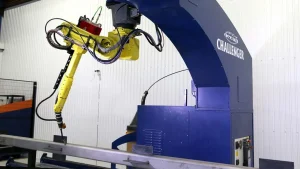

Impact Machinery supplies the Ocean Challenger Welding Robot for automated structural steel fabrication across Australia and New Zealand.
The Ocean Challenger Welding Robot is built for structural steel workshops that want to automate repeatable welding on beams and columns with pre-tacked attachments. At Impact Machinery, we supply the system across Australia and New Zealand and can help fabricators assess whether its workflow suits their production.
What Does the Ocean Challenger Welding Robot Automate?
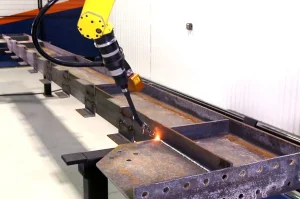
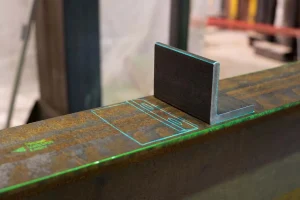
The Challenger is designed to weld attachments that have already been positioned and tack-welded to structural members. Once the member is loaded and selected, the system uses automated programming and robotic welding to complete suitable fillet welds.
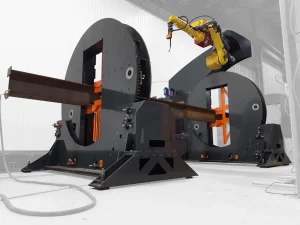
Our Ocean Machinery Challenger product page explains that the system uses software-generated welding paths, automatic rotators and robotic control to process pre-tacked structural components. It suits repeatable beam and column work, but it does not replace cutting, drilling, fitting, tack welding or inspection.
Typical functions include:
- Attachment welding: Weld suitable pre-tacked clips, plates and other attachments to beams or columns.
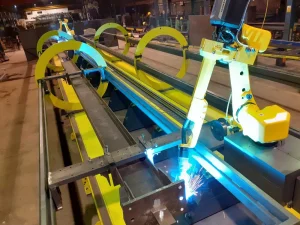
- Rail-based travel: Move the welding robot along the structural member while the workpiece remains positioned.
- Joint location checking: Use laser touch sensing to confirm attachment position before welding.
- Repeatable weld movement: Apply established robotic paths and parameters to consistently prepared components.
Prepare Members Before Robotic Welding
Automation still depends on accurate preparation, with clean, dry components, controlled fit-up and joint gaps required before welding. The robot should not be expected to correct poor fitting, misplaced attachments or unsuitable member condition. Tekla and SDS/2 compatibility also makes accurate digital models important for automated programming and welding-path generation.
Model-Based Programming and Workshop Planning
The Challenger reduces manual robot-programming work by generating welding paths from structural fabrication data. Operators can select the relevant member and allow the software to simulate and plan the welding sequence before processing.
This can reduce repetitive manual arc time, but the business case still depends on the work passing through the workshop. Our Ocean Challenger article for small and mid-sized fabricators discusses where the system may fit fabricators considering repeatable structural work.
Weld Australia’s automation and robotic welding guidance also emphasises assessing automation around the assemblies, integration requirements and production process rather than treating the robot as standalone equipment.
Is the Challenger Suitable for Your Fabrication Workflow?
Before investing, review more than welding speed. Important questions include:
- Member mix: How often do you process beams and columns with repeatable welded attachments?
- Digital detailing: Can your models and fabrication data support the automated workflow?
- Fit-up quality: Are parts consistently positioned and tack-welded before processing?
- Workshop space: Can the cell and loading area fit your layout?
- Production demand: Is there enough suitable work to keep the equipment productively utilised?
Our robotic welding systems range includes different automation options, so the right choice should reflect the fabrication work your workshop actually performs.
Discuss the Ocean Challenger with Impact Machinery
The Ocean Challenger Welding Robot can automate suitable structural steel attachment welding when upstream detailing, fitting and tack-welding processes support the cell. Its value comes from matching the technology to a repeatable workload rather than assuming every fabrication task belongs on the robot.
Contact Impact Machinery with representative member drawings, typical weld requirements and production volumes. We can discuss the Challenger, your workshop requirements and other robotic welding options available across Australia and New Zealand.